| RISK
MANAGEMENT REVIEW |
| |
|
| Managing risk to enhance shareowner value goes
to the very heart of Brait's business. The group places great
importance and priority on its approach to risk management and
has a strong culture of risk management. It recognises that
risk impacts on profitability and is an integral component of
most transactions. A careful process of risk management is employed
to effectively identify, evaluate and assess all types of risks
and to optimise the risk-reward trade-off. |
| |
| Risk management
responsibility and structures |
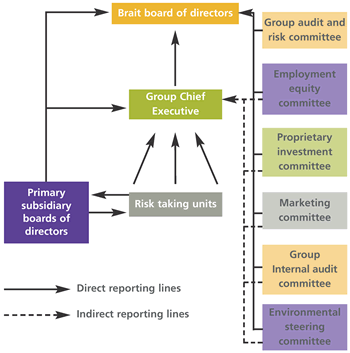
| Ultimate responsibility for the formulation of
risk management policies and the systems of control and review
lies with the board of Brait and the boards of its primary subsidiaries.
There are nonetheless, intervening committees and executives
who have designated responsibility for focusing on specific
risk categories. Effective risk management is also achieved
through the decentralisation of responsibilities to managers
of risk taking units, with reporting lines to the group Chief
Executive and designated risk committees. The risk control structures
are summarised in the following diagram: |
| |
| |
 |
| |
Different types of risks are clearly defined
and such definitions provide the basis for measuring risk and
implementing risk management processes.
The group has risk exposures to market risk, credit risk, interest
rate and liquidity risk, currency risk, solvency risk, operational
risk, legal and compliance risk and strategic risk.These risk
factors are considered below. |
| |
| Page
up |
| Market risk |
Market risk is the potential change in the value
of a financial instrument resulting from changes in market conditions.
On a portfolio basis, this is the risk of a decrease in the
value of the portfolio as a result of an adverse move in market
parameters such as equity prices.
Primary control of risk is established through a comprehensive
limit structure that promotes the alignment of the group's risk
appetite, primarily for proprietary investments.
Investment limits at each control level are approved by the
board and reviewed regularly to ascertain their relevance and
appropriateness. Management is expected at all times to remain
within the prescribed limits.
Brait measures the current profit and loss on its proprietary
investment portfolio monthly, or more regularly if specifically
needed. The monthly reports are supplemented by a full quarterly
review of all investments. Controls are in place to ensure that
other market risk transactions are booked at prevailing market
rates and that positions are revalued at current market prices.
The risk measurement function in the group operates with clear
independence and authority from the operations and reports to
senior management and the board. |
| |
| Credit and
counterparty risk |
Credit and counterparty risk refers to the effects
on future cash flows and earnings of borrowers defaulting on
their obligations. This also covers trading counterparties,
issuers of instruments held by the group or as collateral. Such
risk arises primarily from lending and investment activities
as well as from the settlement of proprietary financial market
transactions and those undertaken on behalf of clients.
Brait manages these risks by setting prudent credit exposure
limits, constantly measuring current credit exposures, estimating
maximum potential credit exposures that may arise over the duration
of a transaction, and responding quickly when corrective action
needs to be taken.
All material credit exposures are governed by authorisation
limits at both subsidiary and Brait S.A. board level.
Impairment provisions for doubtful debts are raised throughout
the year and approved by the audit and risk committee. |
| |
| Interest
rate and liquidity risks |
Interest rate risk refers to the impact on future
cash flows and earnings of assets and liabilities of interest
rates repricing either at different points in time or on a different
basis.
Exposures to interest rate movements are managed by a combination
of floating and fixed rate instruments, which give the group
its desired maturity profile. The interest rates of the majority
of the group's term borrowings have been fixed in order to minimise
the risks of interest rate volatility and match the estimated
yield of the underlying assets funded with the borrowings, where
applicable. The maturity of borrowings is disclosed in the notes
to the financial statements.
Liquidity risk arises in the general funding of the group's
activities when there are mismatches between the sizes and maturities
of assets and liabilities and also in its Funds Management and
trading operations. The liquidity risk refers to the ability
of the group to meet its financial obligations as they fall
due. |
| |
| Page
up |
| |



