 |
|
|
| |
|
|
| |
|
|
| SEGMENTAL
REVIEW |
| SPECIALISED
FUNDS (CONTINUED) |
| |
|
| International
overview |
In recent years the hedge fund industry has moved
into mainstream thinking, due to the ability to offer alternative
sources of alpha and meaningful diversification in a world that
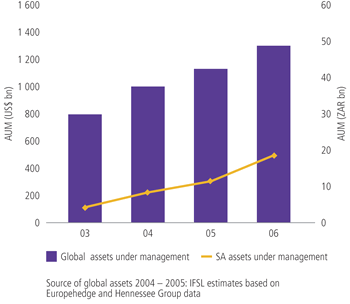
is contracting due to globalisation. Industry assets top the
US$1,3 trillion mark, having grown approximately 25% per annum
since 1990, with more than 10 000 funds.
The key is that specialised strategies and broad mandates allow
essentially non-correlated performance, often with lower volatility.
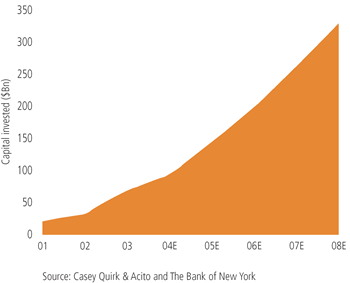
According to the Bank of New York, "Institutions, particularly
pension funds and endowments, will become the primary source
of capital for hedge funds. Their demands will transform the
industry."
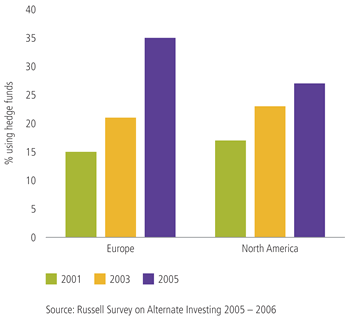
This increase in utilisation of hedge funds by institutions
is confirmed by a survey performed during 2005-2006 by the Russel
Investment Group. This survey, which was based on responses
from 327 large organisations responsible for managing tax exempt
assets, indicated that the utilisation of hedge funds by such
institutions had increased from 21% in 2003 to 35% in 2005 in
Europe and from 23% in 2003 to 27% in 2005 in North America.
The results of this survey also suggest that globally alernative
assets are poised for rapid growth and are expected to reach
record levels by 2007, and that hedge fund assets are likely
to continue to garner a significant share of increased commitments
amongst alternatives.
Trends in fee levels: According to an article in Business Standard,
there is a clear desire and ability of the newer funds in the
global industry to charge higher fees. No longer are funds charging
a 1% management fee and 20% performance fee – the norm
for the first generation of funds set up in the early 1990's. |
| |
| |
| Increased utilisation of
hedge funds by institutions |
 |
| |
| |
| Growth of US institutional
hedge fund capital |
 |
| |
| One of the most notable trends in the international
hedge fund arena has been the increased scrutiny placed on infrastructure
and operational risk areas, and the regulatory drive towards
valuation independence. Investment managers focused on portfolio
management are finding these demands onerous, and are increasingly
utilising outsourced expertise to pass muster. |
| |
| South African
overview |
The EuroHedge Special Report, "South Africa:
A new hedge fund market emerges", February 2006, states that
"South Africa's hedge funds are rapidly evolving into an impressive
industry . . ., which stands out among global emerging markets".
A contributor states, "New funds are being started at a phenomenal
rate . . . According to our database, there were about 65 hedge
funds one year ago, and now its up to 84 . . .", and industry
assets are estimated at around R12 billion at the end of 2005.
In the section covering funds of hedge funds entitled "Competing
hard for distinctive niches", the following observation is noteworthy:
". . . Brait has emerged as the largest, and certainly, the
most innovative FoHFs manager in South Africa. What distinguishes
Brait from its competitors, is that it has pioneered long-term
capacity agreements with talented managers and has developed
an incubator model that has nurtured 17 hedge funds . . ." |
| |
| |
| Global and SA hedge fund
growth |
 |
| |
| Strategic
initiatives |
| We remain focused on delivering expected performance
within specialised mandates utilising hedge fund strategies,
and aim to expand our capabilities during the year ahead through
specific product developments. We are in advanced stages of
launching a large multistrategy fund, which promises to enhance
our abilities to deliver exciting performance whilst minimising
operational risk. In addition, we believe that an increasing
client base, including international investors attracted to
South Africa's macro-economic developments, will expect more
customised solutions, which our experience in the industry suggests
we can now accommodate. |
| |
| Page
up |
| |
|
|
|
|
|
|
| |
|
 |

