 |
|
|
| |
|
|
| |
|
|
| SENIOR
CHAIRMAN'S STATEMENT (continued) |
| |
|
| Macro environment |
| Despite widening global current account imbalances,
rising oil prices, and natural disasters, the global economy
expanded at a respectable pace of 3,4% during the course of
2005. This slowdown, somewhat slower than the 4,0% recorded
the previous year, was mainly precipitated by more expensive
energy costs, but was also influenced by capacity constraints
in the resources sector and by the effects of tightening monetary
policy in the United States. The relatively faster pace at which
China and India grew, compared with the rate by which industrialised
economies grew, bolstered global financial stability during
2005. Against this background, the South African economy registered
another impressive performance. |
| |
| |
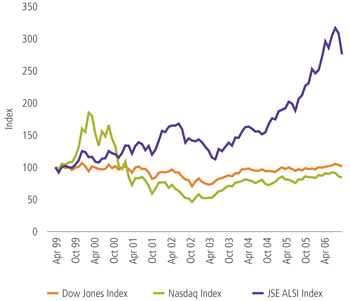
Relative international market
trends
Index 1999 = 100 |
 |
| |
One of the most significant achievements for South
African policymakers, over the past year, has been the elevation
of the country's sovereign rating to the upper end of the lower
investment grade rating. The Baa1 rating by Moody's and the
BBB+ rating by Standard & Poors are significant acknowledgements
of South Africa's favourable mix of macro-economic, fiscal and
monetary policy. These ratings, in place for 30 consecutive
quarters, acknowledge the upward trend in economic growth. The
4,9% rate at which gross domestic product grew in 2005 is the
fastest annual rate of expansion since 1984. While the economy
remained in an upward phase of its business cycle, the longest
on record, foreign investors took note that economic activity
continued to take place.
Interest in domestic securities rose to an historic high, and
foreign direct investment interest remained encouraging, with
two of the largest inward investments on record, in the banking
and telecommunications sectors, being registered. With the scorecard
on key policy issues becoming increasingly impressive, the environment
for private equity investments looks promising. |
| |
| |
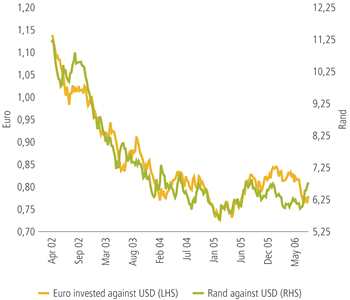
| Historical exchange rate
movement |
 |
| |
| The challenges facing policymakers today are generally
external in nature, relating to the impact monetary tightening
has on emerging markets, such as South Africa. The economy,
which is not immune to developments beyond its control, has
shock-absorbers in place which suggest that it is capable of
weathering external influences better than it has in the past,
and generally better than many other developing economies. The
inflation targeting mechanism, in place since 2001, has been
successfully managed, to the extent that inflation, excluding
mortgage rates, has been within its designated range for 31
consecutive months. Inflation averaged 3,9% in 2005, the lowest
on record. Another economic achievement has been the turnaround
in reserves, facilitating a more stable outlook towards the
currency than previously. |
| |
| Page
up |
| |
|
|
|
|
|
|
| |
|
 |

