| EMPLOYEE
REPORT CONTINUED |
| |
|
| Human capital
development |
| Mentorship and coaching initiatives will always
be the cornerstone of manpower development within Brait. Learning
and development is a core part of Brait's human capital strategy,
with two main objectives: |
| |
| • |
To grant each employee the opportunity to
achieve his or her potential in pursuit of organisational
objectives; and |
| • |
To provide a challenging work environment and opportunities
for personal growth. |
|
| |
This strategy serves to facilitate the effective
transfer of essential areas of knowledge to Brait's future executives
whilst allowing for development of character, values and individualised
career development. Opportunities exist for staff to develop
broad business skills ranging from financial analysis and valuations,
to business and people management, as well as investor relations.
Brait's emphasis on this form of development has resulted in
the formation of closely-knit multi-cultural teams joined by
strong relationships and commonality of purpose. Standards of
performance are clearly understood and team members promote
and reinforce the consistent and ethical application thereof.
Through the introduction of structured and customised Trainee
Emerging Manager and employee development programmes, efforts
are made to develop the potential of existing staff and provide
a future channel of potential managerial and senior staff resources
for different areas of the business.
Staff are encouraged to continually improve on their levels
of skill and personal development. The amount expended on skills
development, during the period under review, was ZAR470 000.
In support of this, training and educational programmes are
regarded as essential components of the group's investment in
human capital. A closed bursary scheme is available to all staff,
and an amount of ZAR212 000 has currently been utilised through
this scheme. |
| |
|
|
| Brait closed
bursary scheme |
Number of
employees |
|
| Certificates/Diplomas |
1 |
|
| Degrees |
2 |
|
| Postgraduate degrees |
5 |
|
| |
8 |
|
|
|
|
|
| |
| Effective communication throughout the organisation
is vital to sustain manpower strategies and serves to develop
a culture of openness, honesty and trust. |
| |
| |
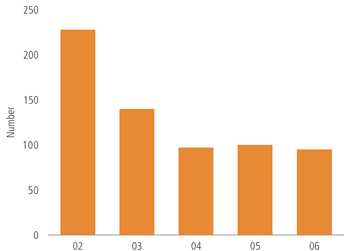
| Group headcount at 31 March
2006 |
 |
| |
| Transformation
and diversity in South Africa |
Brait's human resource structure continues to
focus on the strategy of recruiting and retaining the best individuals
from South Africa's diverse population base. Recruitment standards
are high and leadership is measured on the recruitment, development
and retention of intellectual talent.
There has been strong progress towards the realisation of equity
objectives. Despite a progressive reduction in employee numbers,
Employment Equity targets established in the 2001 Employment
Equity report have been exceeded during this financial year.
Workforce demographics show a progression over the past four-year
period which reflects the overall objective and intent of Brait,
that workforce demographics must, more closely, reflect the
demographics of the economically active South African population
as a whole. This trend will continue as objectives are consistently
met.
A fully representative Employment Equity committee ensures regular
workforce analysis to monitor the achievement of defined numerical
targets and to ensure fair and equitable employment practices.
Transformation continues to be driven on several fronts including
social investment, black economic empowerment initiatives, corporate
social investment and employment equity initiatives.
Although Brait has progressed well with regard to its transformation
process, female representation at senior and executive levels
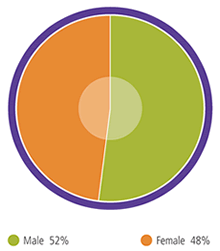
remains a priority. Overall, females represent 48% of the total
group workforce, however, improvement is required with regard
to representation at senior levels. Strategies have been put
in place that are aimed at the identification of professional
female talent in the marketplace, and the Private Equity division
has appointed a female director this year. |
| |
| Page
up |
| |
Group gender representation
at 31 March 2006 |
 |
| |
| |
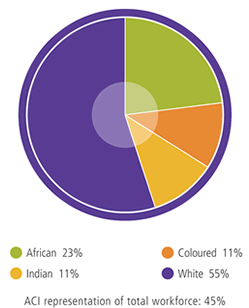
Group equity representation
at 31 March 2006 |
 |
| |
| |
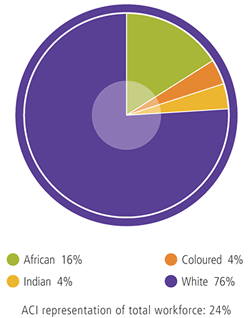
Group equity representation
at 31 March 2003 |
 |
| |
| Changes in workforce demographics are reflected
when comparing the period ended 31 March 2003 to the current
period under review, ending 31 March 2006, as shown above: |
| |
| Page
up |
| |



